
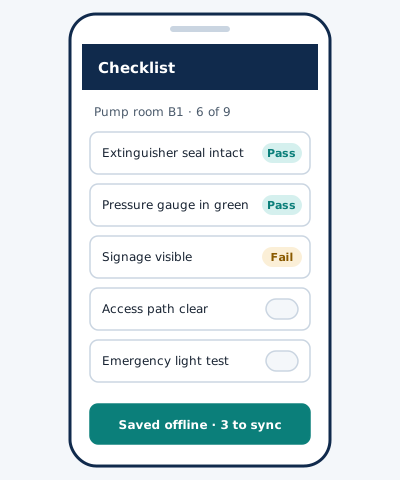
Field inspection checklist app
Offline checklists, defect photos and a supervisor board for routine equipment inspections.
Demonstration project · not a client case
index.phpHomeservices.phpServicesrequirements-analysis.phpRequirements analysissoftware-design.phpSoftware designdevelopment-implementation.phpDevelopment & implementationdemo-projects.phpDemo projectsdemo-field-inspection.phpField inspection checklist appdemo-stock-reorder.phpStock and reorder dashboarddemo-room-booking.phpMeeting room booking portaldemo-service-desk.phpInternal service request portalguides.phpGuidesguide-preparing-requirements.phpG1 How to prepare requirements before talking to a developerguide-build-or-buy.phpG2 Build, buy or configureguide-discovery-phase.phpG3 What a discovery phase is for, and what it should not doguide-fixed-price-or-time-and-materials.phpG4 Fixed price or time and materialsguide-pdpa-for-software-projects.phpG5 PDPA basics for software projects in Singaporeabout.phpAboutcontact.phpSend a briefRequirements analysis, software design and development & implementation for organisations in Singapore. Choose a demonstration project and follow one requirement through all three phases.
Select a requirement to trace it.
Wireframes of the example, not product screenshots.
M-1Local store and sync queueIncrement 1 · tests from the criteria of R-1M-2Media upload serviceIncrement 2 · tests from the criteria of R-2M-3Reporting API and exportIncrement 3 · tests from the criteria of R-3Every module ships with automated tests.
Select a requirement to trace it.
Wireframes of the example, not product screenshots.
M-1Stock level calculatorIncrement 1 · tests from the criteria of R-1M-2Purchase order moduleIncrement 2 · tests from the criteria of R-2M-3Stock movement ledgerIncrement 3 · tests from the criteria of R-3Every module ships with automated tests.
Select a requirement to trace it.
Wireframes of the example, not product screenshots.
M-1Availability queryIncrement 1 · tests from the criteria of R-1M-2Booking rules engineIncrement 2 · tests from the criteria of R-2M-3Admin and audit logIncrement 3 · tests from the criteria of R-3Every module ships with automated tests.
Select a requirement to trace it.
Wireframes of the example, not product screenshots.
M-1Intake and routing rulesIncrement 1 · tests from the criteria of R-1M-2Queue serviceIncrement 2 · tests from the criteria of R-2M-3Notification workerIncrement 3 · tests from the criteria of R-3Every module ships with automated tests.
Demonstration only: invented scenarios, not client projects and not results.
Each phase starts from the artefacts of the one before. You can book a single phase or all three; the documents stay with you either way.
Four invented projects, each documented phase by phase: user stories, a container diagram, a design decision record and an increment plan. They show the shape of the work, not past clients.
Offline checklists, defect photos and a supervisor board for routine equipment inspections.
Demonstration project · not a client case
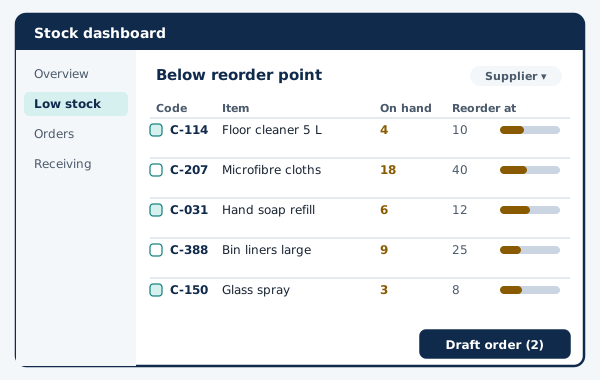
A low-stock list, purchase order drafts and a movement ledger for one small warehouse.
Demonstration project · not a client case
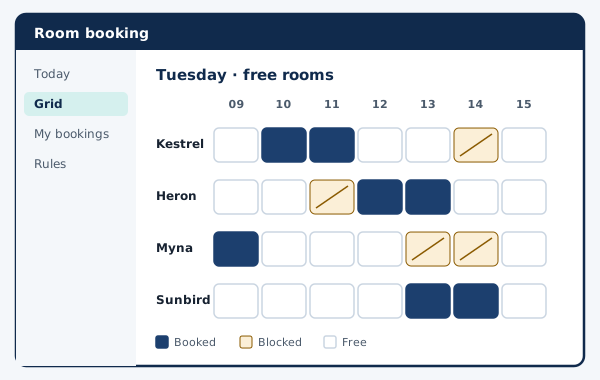
Live availability, check-in to keep a booking, and maintenance blocks for a shared office floor.
Demonstration project · not a client case
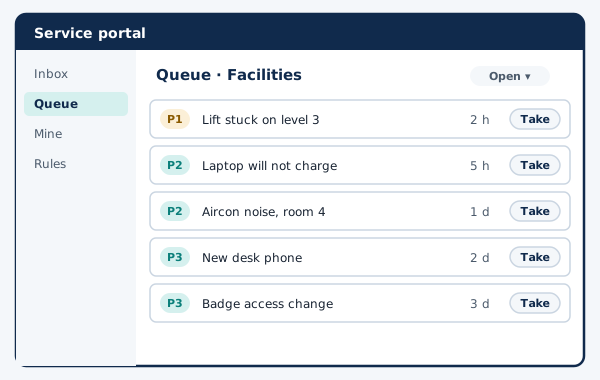
One intake form, routing rules, an agent queue and status e-mails for IT and facilities requests.
Demonstration project · not a client case
Short guides on questions buyers ask early. Every rule or figure links to its public source.
G1How to prepare requirements before talking to a developerWhat to write down, what to leave open, and how to describe a feature so that everyone knows when it is done.
G2Build, buy or configure: choosing how to get the software you needWhen custom development makes sense, when an off-the-shelf product is the better choice, and the risk of modifying products.
G3What a discovery phase is for, and what it should not doDiscovery explained using public guidance: its purpose, its outputs, and why stopping after discovery can be the right result.
G4Fixed price or time and materials: choosing a way to work togetherHow the two common contract models share risk, what public-sector guidance recommends for agile work, and what to ask for in either model.
G5PDPA basics for software projects in SingaporeThe PDPA obligations that shape requirements and design: consent, purpose, retention, transfers, breach notification and data intermediaries.
Or write to [email protected] or call +49 781 12786346.