
Requirements analysis for custom software
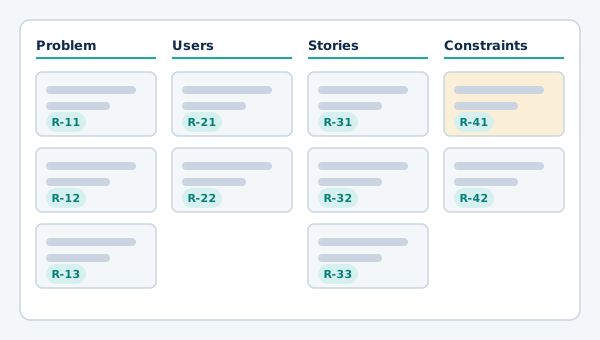
Before anyone designs a screen or estimates a feature, we work out which problem the software has to solve, for whom, and under which constraints. The output is a set of written artefacts that your team can read, challenge and keep.
When this helps
- You have a clear business need but no agreed description of what the software should do.
- Several departments want different things from the same system.
- A previous attempt stalled because nobody could say when a feature was done.
- You want to compare building, buying or configuring before committing (see the guide on build or buy).
How the work runs
- Frame the problem. We restate any pre-defined solution as a problem to solve and agree what is outside it. The GOV.UK Service Manual recommends this reframing for the discovery phase, together with a clear goal so the work has a natural end (GOV.UK Service Manual).
- Talk to the people who will use it. Short interviews and observation of the current process, including the paper, spreadsheet and e-mail steps that rarely appear in a specification.
- Write user stories. Each story names an actor, a need and a goal, in the form As a… I need… so that…, which is the structure described in the GOV.UK guidance on user stories. Every story gets acceptance criteria phrased as it is done when…
- Check story quality. We review stories against the INVEST checklist (independent, negotiable, valuable, estimable, small, testable) proposed by Bill Wake.
- Record constraints. Legal and contractual constraints, existing systems, data protection duties such as the Singapore PDPA, accessibility targets and hosting limits are listed separately from features.
- Order the backlog. Stories are ordered by value and dependency, so the first increment can be small and still useful.
Artefacts you receive
| Artefact | What it is for |
|---|---|
| Problem statement | One page: the problem, who has it, what is out of scope. |
| Stakeholder map | Roles, interests and who decides what. |
| User stories with acceptance criteria | The shared definition of done for each feature. |
| Non-functional requirements | Performance, security, accessibility, data protection, operation. |
| Prioritised backlog | The order in which value can be delivered. |
| Open questions log | Decisions still needed, with an owner. |
What we need from you
- One person who can make decisions about scope.
- Access to future users for interviews.
- Existing documents, forms, spreadsheets and system exports.