
Development and implementation
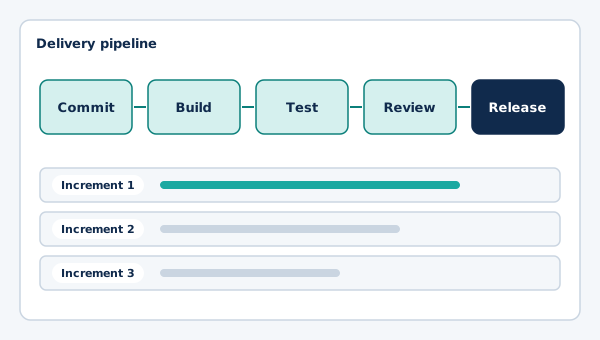
We build in short increments, each ending in software that runs, is tested and can be shown to users. Implementation includes the parts that are easy to forget: data migration, deployment, monitoring, documentation and handover.
When this helps
- Design artefacts exist, ours or from another team.
- A prototype has to become a maintained product.
- An internal tool needs to be rebuilt in a way that can be handed over.
How the work runs
- Set up the foundations. Repository in your name, automated build, environments and configuration kept out of the code, following principles such as those collected in The Twelve-Factor App.
- Deliver increments. Each increment is demonstrated on working software. Feedback goes back into the backlog.
- Test continuously. Unit and integration tests run on every change; acceptance criteria from the analysis phase become test cases.
- Migrate data. Import scripts are rehearsed on copies of real data before go-live.
- Release and monitor. Repeatable deployments, logs and alerts agreed with your team.
- Hand over. Runbook, architecture records, admin guides and a walkthrough for the people who will maintain the system.
Artefacts you receive
| Artefact | What it is for |
|---|---|
| Source code and history | In a repository owned by you. |
| Automated tests | Linked to acceptance criteria. |
| Deployment pipeline | Scripts and configuration for each environment. |
| Migration scripts and reports | What was imported and what was rejected. |
| Runbook | Backups, restores, credentials, alerts. |
| Handover session notes | Questions answered, open items listed. |
What we need from you
- A product owner available for increment reviews.
- Access to hosting or a decision on where the system will run.
- Test data or anonymised copies of real data.